Our Curriculum
Curriculum Intent
Laceby Acres Academy is an enquiry driven school; there is a belief that learning is about retaining knowledge and developing life -long skills that enable learning for the 21st Century.
Our children are very well prepared for the next stages in their education as we work hard give them a secure grounding in basic skills, including reading, writing, spelling, grammar, secure mathematical understanding and confidence in the use of ICT. We firmly believe in furnishing our young people with a set of learning tools, attitudes and habits that they will be able to use throughout their lives, even when faced with unfamiliar challenges. We believe in delivering a curriculum that is designed to meet the needs of OUR children and serves to challenge them to reach their full potential academically, socially and emotionally.
Developing Respectful Thinkers and Learners
There is an emphasis on quality across the curriculum. ‘Fewer things in better quality’ is a focus in classrooms and allows us to develop a depth of learning.
The theory behind ‘Austin’s Butterfly’ is our mantra when it comes to improving performance; pupils support each other with clear and precise guidance for improvement through Critique. We believe in developing a ‘mastery of learning’ approach so every child is challenged and supported to a secure foundation of understanding. Strategies are used to ensure they are given a chance to practise and perfect performance; Critique and Collaboration are key. We recognise children grasp learning in different ways and at different speeds and our practice reflects this.
We also ensure they are respectful and tolerant members of society, by developing an understanding of different beliefs and cultures; this is reflected in our spiritual, moral, social and cultural curriculum and support by the academy drivers.
Curriculum Content
We have chosen to devise a knowledge-based curriculum in line with the skills promoted in both, the National Curriculum and the Early Years Foundation Stage Framework as this suits the needs of our pupils. We identify non-negotiable facts to learn, which contributes to their general knowledge. This enables pupils to grow on a personal and academic level, allowing them to perceive, understand and analyse situations effectively. We focus on planning an academic grounding for children that meets their needs in the world they live in and allows them to make progress with us and beyond in the next stage of their education. Four subjects drive our curriculum: history, geography, science and design and technology. Geography ensures pupils develop key knowledge of the local area and the wider world, while history teaches how significant individuals and events from the past have helped shape it. Science and DT provide essential knowledge and skills necessary for future careers in the 21st century, in industries along the Humber Bank.
In addition to the academic curriculum, we provide children with a Laceby Acres Experience that ensures they know their place in the world and that this is built on the belief that key activities, visits and experiences are key to childhood enjoyment and learning. Please see the document detailing this.
A People Day, where each phase learns about a significant individual linked to the driving subject, is used to start each topic. This ensures the children develop knowledge of key individuals, who have shaped the world they live in.
Curriculum Approach
We have a whole school themed approach to the curriculum, which is driven by enquiry questions, specific to each cohort. The curriculum is organised on a two-year cycle. We ensure that all learning is purposeful and every cohort uses a quality text as the stimulus for each theme. In addition to this, the school uses the Enquire Computing Curriculum and follows the North East Lincolnshire Locally Agreed Syllabus for Religious Education.
Curriculum Planning
The timing of each topic, and the length of time each topic lasts for, is driven by the needs of the children. Learning teams work together to plan the curriculum for the term. Topics are sequential in content and allow for knowledge and key concepts to be revisited and built upon.
Curriculum Monitoring
Areas of the Curriculum are monitored by teams of staff. They use a variety of Curriculum Monitoring processes to ensure coverage, progression and high standards in their areas. Standards attained in the core subjects are demanded in cross curricular work.
Details of individual National Curriculum subjects for each academic year group can be found at: https://www.gov.uk/government/collections/national-curriculum
Foundation stage at Laceby Acres is a welcoming and exciting place for your child to begin their journey through our school. A safe and friendly environment enables the children to flourish and learn. They are supported and encouraged to develop as independent individuals, who can interact with their friends, to explore and share new experiences. The children expand their communication and interaction skills, physical abilities and personal, social and emotional development. The love for reading is stimulated by sharing stories, books and role play. We use Little Wandle to teach reading and writing. In Maths, they have lots of practical fun mastering number facts and patterns to 10, counting beyond and investigating shape and measure. They enrich their understanding of the World through real life experiences, books and digital resources and their creativity is expressed through a variety of media. It is brilliant becoming Year 1 ready!
Little Wandle Letters and Sounds Revised
Phonics (reading and spelling)
At Laceby Acres Academy, we believe that all our children can become fluent readers and writers. This is why we teach reading through Little Wandle Letters and Sounds Revised, which is a systematic and synthetic phonics programme. We start teaching phonics in Foundation Stage and follow the Little Wandle Letters and Sounds Revised progression, which ensures children build on their growing knowledge of the alphabetic code, mastering phonics to read and spell as they move through school.
As a result, all our children are able to tackle any unfamiliar words as they read. At Laceby Acres Academy, we also model the application of the alphabetic code through phonics in shared reading and writing, both inside and outside of the phonics lesson and across the curriculum. We have a strong focus on language development for our children because we know that speaking and listening are crucial skills for reading and writing in all subjects.
Comprehension
At Laceby Acres Academy, we value reading as a crucial life skill. By the time children leave us, they read confidently for meaning and regularly enjoy reading for pleasure. Our readers are equipped with the tools to tackle unfamiliar vocabulary. We encourage our children to see themselves as readers for both pleasure and purpose.
Because we believe teaching every child to read is so important, we have a Reading Leader who drives the early reading programme in our school. This person is highly skilled at teaching phonics and reading, and they monitor and support our reading team, so everyone teaches with fidelity to the Little Wandle Letters and Sounds Revised programme.
Phonics Overview
At Laceby Acres, we want our children to be confident and questioning readers who actively engage and interact with the stories and texts they come across throughout their school life. The ability to read is fundamental to pupils’ development as independent learners. In order to read across the curriculum with fluency, accuracy, understanding and enjoyment pupils need to orchestrate the range of strategies, depicted in the National Curriculum, drawing on knowledge of context and grammatical knowledge; applying phonic knowledge and skills; applying graphic knowledge and developing word recognition.
Our approach to reading sees children progress through daily systematic synthetic phonics in line with the accredited Little Wandle and Collins Big Cat scheme in Early Years and KS1, into guided group reading settings where children focus on building their fluency of sentence reading and begin to develop more comprehension of what they are reading in Year 2. Further, we also use the Oxford Reading Tree and Bug Club Reading schemes for home reading. As the children move into KS2 then further develop their understanding of the core reading skills through reciprocal reading strategies that enable children to develop their own reading acumen.
We have our Curriculum statement including our intent, implementation and impact statements as well as our approach to children’s reading journey through our school. Our approach entwines reading and writing together using the reading to writing sequence where we give reading a clear and vital purpose through engaging and interacting with high quality texts and showing the important role reading has in being able to write.
Reading Overview
Our reading approach aims to develop children into independent questioning readers who enjoy reading. We hope to create life-long readers who seek enjoyment and knowledge. Reading has the power to allow children to access the whole curriculum and become fantastic learners and that is why we strive to give children different strategies to help them become fluent, we strive to give children as many different reading experiences and opportunities we can offer and we strive help every child of every ability at reading to make as much progress as they can.
Reading at Laceby Acres
At Laceby Acres, we want our children to be confident cohesive writers who have a great attitude towards writing. We want to give them the skills and tools necessary to develop into young writers in which they can express themselves and their view points in any subject across the curriculum. We also set high standards and expectations of our children and their writing, supporting and challenging them to create the very best piece of writing they can.
We have developed our own metacognitive approach to crafting writing in which children build up their skills, stamina, creativity and knowledge of text types through engaging and interacting with high quality texts. We want to ensure our children are given the time to craft high quality pieces of a wide range of different text types, learning different features of grammar, spelling and genre based writing features. At Laceby Acres we want to develop confident writers, who strive to edit and improve any piece they do through our robust editing system that starts in KS1.
Writing Overview
At Laceby Acres, we want our children to be confident cohesive writers who have a great attitude towards writing. We want to give them the skills and tools necessary to develop into young writers in which they can express themselves and their view points in any subject across the curriculum. We also set high standards and expectations of our children and their writing, supporting and challenging them to create the very best piece of writing they can.
Writing at Laceby Acres
At the centre of the mastery approach to the teaching of mathematics is the belief that all children have the potential to succeed. They should have access to the same curriculum content and, rather than being extended with new learning, they should deepen their conceptual understanding by tackling challenging and varied problems. Similarly, with calculation strategies, children must not simply rote learn procedures but demonstrate their understanding of these procedures through the use of concrete materials and pictorial representations. This policy outlines the different calculation strategies that should be taught and used in EYFS to Year 6 in line with the requirements of the 2014 Primary National Curriculum.
Maths Overview
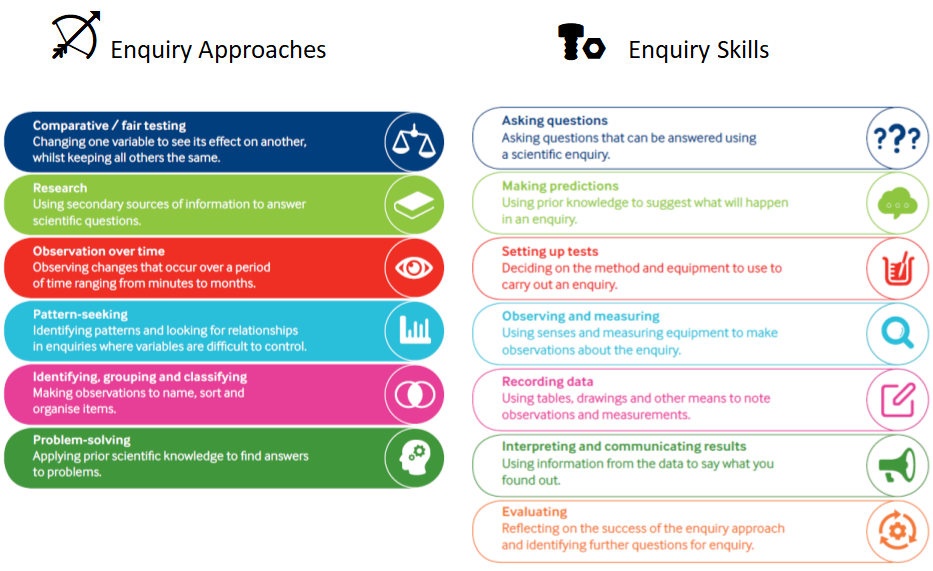
In Science, we seek to develop a broad, rich and rigorous curriculum that stretches and challenges all our students. Our clear and precise progression framework outlined below, allows teachers to plan for progression and ensure they are aware of the continuity across year groups and topics. The framework documentation highlights the key teaching points as well as making explicit links to the enquiry skills and approaches being alluded to in each task.
Children should have the opportunity to carry out practical investigations in science that help them to develop their scientific skills. These are the skills that scientists need to carry out research and are sometimes referred to as a cycle of plan, do, review. Our children will be given the opportunity explore practical experiments as well as having access to equipment, providing them with a sense of ownership to be able plan their own scientific investigation.
Our curriculum design allows for the inclusion of all learners, achieved through differentiation and wide range of assessment opportunities. The ‘Big Questions’ outlined within the progression documentation, allow for AFL to take place and enables teachers to plan the topic in response to the children’s specific needs.
Science teaching at Laceby Acres Primary Academy aims to give all children a strong understanding of the world around them whilst acquiring specific skills and knowledge to help them to think scientifically, to gain an understanding of scientific processes and also an understanding of the uses and implications of Science, today and for the future.
Ultimately, a strong understanding of Science will allow children to understand concepts, recognise the importance of rational explanation, develop their ability to explain the world around them, predict, analyse and broaden their vocabulary, all while developing a sense of curiosity and excitement for the natural world. Here at Laceby Acres Academy our belief is that science is vital to the world’s future prosperity, and as educators, our role is to develop key scientific skills and knowledge alongside a sense of curiosity and excitement and in doing so we will be creating the scientists of the future.
Science at Laceby Acres
Children must be given the opportunity to practise scientific enquiry skills. These are the skills that scientists need to carry out research and are sometimes referred to as a cycle of plan, do, review. Teachers should be aware of the progression of these skills across the primary phases and plan to teach and assess these skills within children's practical investigations. For example, if children are recording data in a table.
Over the course of an academic year, pupils should carry out several investigations that involve different types of enquiry. This ensures the lesson and task design has a primary science focus (isn’t a hidden literacy task). Allowing the children to progress as scientists.
Science Planning
The Laceby Acres long term History plan, alongside our ‘Big Ideas’ summary gives an at a glance synopsis of the topics covered from EYFS to Y6. It also allows for an overview of how our History curriculum is mapped for each year group over the academic year. The symbols reflect how progression is made over time and are linked to our ‘Build an Overview’ themes which reflect the concepts required to build pupils substantive knowledge.
To cultivate a deeper understanding of history a clear progression route is in place as well as opportunities to revisit topics from previous years. Alongside this, cross-subject links and references are practiced to help students embed holistic knowledge.
In addition to this the overview incorporates symbols to represent the declarative knowledge that pupils can develop to become historians. These methods of enquiry (communicate historically, interpret historically, historical enquiry and understand chronology) are sewn into each lesson to bring out the historian in every child.
History Overview
At Laceby Acres Academy, we have chosen to use the Rising Stars History scheme of work as the basis for our History Curriculum. In each unit of work the key knowledge, skills and vocabulary are identified, which ensures that the children are revisiting the Threshold Concepts in each unit. A progression framework for History has been developed, which allows us to make accurate assessments as to whether the children are working towards, working at or exceeding expectations. A high quality children’s text is central to our delivery of each historical unit of work.
We use a range of pedagogical approaches, which support the teaching of History. Our philosophies for teaching history have been designed to develop our pupil’s substantive and disciplinary knowledge through four methods of enquiry that meet the criteria for successful historians. We embed these skills into each lesson and pupils have the opportunity to progress their skills in this area as they move through the history curriculum. We have also introduced History Ambassadors to promote History throughout the school and they have recently been able to work with Heritage Lincolnshire to discover about local hero Edward Watkin.
We have crafted structured knowledge organisers to ensure children are able to explore the substantive knowledge required with a leading question each week designed to develop pupil’s disciplinary knowledge. Emphasis is placed on retaining their newly acquired understanding of each topic resulting in a change in their long term memory. We measure the impact of our History Curriculum in several ways. Firstly, we use the History Progression Framework to measure, through use of progressive milestones, whether a child is working towards, meeting or exceeding in their knowledge, skills and understanding of the Threshold Concepts. At Laceby Acres Academy, we expect all children to produce beautiful work and to take pride in their learning outcomes. We regularly scrutinise work books to check that these standards are being upheld.
History at Laceby Acres
At Enquire Learning Trust, we believe that it is vital for all our pupils to learn from and about Computing and Technology, so that they can understand the world around them. Through teaching our computing curriculum, we aim to equip our children to participate in a rapidly changing world where work and leisure activities are increasingly transformed by technology. It is our intention to enable children to find, explore, analyse, exchange and present information as well as having the skills to manipulate, develop and interpret different forms of technology in an ever-changing world.
In such a fast-moving curriculum, we are constantly looking at new ways of delivering relevant and exciting activities, while still delivering the fundamental skills needed for computing. Using technology safely and responsibly is a main priority and ensuring all pupils are able to use the internet and equipment appropriately is of paramount importance. We encourage our pupils to make links across the curriculum, the world and our local community, to reflect on their own experiences, which are designed in our curriculum, allowing horizontal and vertical links with previous year groups.
The core of computing is computer science, in which pupils are taught the principles of information and computation, how digital systems work, and how to put this knowledge to use through programming. Building on this knowledge and understanding, pupils are equipped to use information technology to create programs, systems and a range of content. Computing also ensures that pupils become digitally literate – able to use, and express themselves and develop their ideas through, information and communication technology – at a level suitable for the future workplace and as active participants in a digital world.
Our ambitious computing curriculum is now structured in 3 areas that allow all pupils from EY to year 6 to progress through different categories of knowledge. These are:

Computing Overview
At the Laceby Acres we believe that our students should have the opportunity to follow an IT and Computing curriculum that prepares them for life in modern Britain and take advantage of opportunity this can offer them in both Britain and the wider world. Good quality IT skills enable student to engage positively within the modern work place, while Computer Science skills enable students to take an active part in the design, development and creation of new technologies to be used in the world in which they live.
In line with the 2014 National Curriculum for Computing, our aim is to provide a high-quality computing education, which equips children to use computational thinking and creativity to understand and change the world. The curriculum will teach children key knowledge about how computers and computer systems work, and how they are designed and programmed. Learners will have the opportunity to gain an understanding of computational systems of all kinds, whether or not they include computers.
It is our intention to enable children to find, explore, analyse, exchange and present information in a safe, responsible and respectful manner. We also focus on developing the skills necessary for children to be able to use information in a discriminating and effective way. Our computing curriculum enables children to develop their problem solving and reasoning abilities. It enables children to understand and apply the essential principles and concepts of Computer Science, including logic, algorithms and data representation, analyse problems in computational term, and have repeated practical experience of writing computer programs in order to solve such problems.
Computing at Laceby Acres
At Laceby Acres, we understand that in an ever growing world in which children are using the internet via numerous sources i.e. their computers, their phones, their tablets etc, the need for children to understand and appreciate the importance of being safe and responsible when accessing the internet is more important than ever.
A core component of our computing curriculum involves teaching a wide array of subjects on the subject of Online Safety. As per our Keeping Children Safe in Education (KCSIE) Policy, the 4 Cs that we teach pupils about are:
Content
Content refers anything that you see online that has been posted by another individual. This can include: videos, images, news articles, social media posts. Children are at risk of seeing content that is illegal, inappropriate and/or harmful. This can include: pornography, fake news, discrimination, suicide, radicalisation.
Contact
Contact refers to any interaction that one has online with another individual; be it with friends, family, or strangers. Children are at risk of things like peer-to-peer pressure, cyber-bullying, targeted advertising. Sometimes children may encounter people online that they believe to be the same age as themselves, but in fact the other person is an adult posing as a child with the intention of grooming or exploiting children for sexual, criminal, and/or financial purposes.
Conduct
Conduct refers to how people interact and behave online with each other. Whilst most interactions can be positive/neutral, due to the anonymity of these interactions, there is an increased likeliness in behaviour that can be harmful such as cyberbullying, sexting, sharing inappropriate content, and/or sharing nudes and pornographic material.
Commerce
Commerce refers to anything that may be of a monetary/transactional nature. Indirectly, this can include inappropriate advertising and phishing attempts for i.e. personal information, card details etc. More directly, this can involve online gambling, microtransactions in video games, and financial scams i.e. falsely advertised products.
Parents also have a responsibility to teach their children the importance of online safety as well; adults can be just as susceptible to these things as children are. To that end, we kindly ask that parents please read and watch the material that is available for them below, so that you yourself are not just informed on these various matters of Online Safety, but also so that you can communicate with your children more effectively about Online Safety.
Online Safety Documents
The Enquire Learning Trust bespoke computing curriculum offers a cross curricular scheme of work for EYFS, Key Stage 1 and Key Stage 2 which matches the expectations of the National Curriculum. The curriculum looks at the progression needed for all pupils to develop and embed skills and knowledge within the strands of: computer science, information technology and digital literacy. The curriculum is designed to support teaching and learning and the acquisition of subject knowledge in all areas. Children will have the opportunity to explore and respond to key issues such as digital communication, cyber-bullying, online safety, security and social media.
Aims
The curriculum for computing aims to ensure that all pupils:
- Can understand and apply the fundamental principles and concepts of computer science, including abstraction, logic, algorithms and data representation
- Can analyse problems in computational terms, and have repeated practical experience of writing computer programs in order to solve such problems
- Can evaluate and apply information technology, including new or unfamiliar technologies, analytically to solve problems
- Are responsible, competent, confident and creative users of information and communication technology.
Key Stage 1
Pupils should be taught to:
- Understand what algorithms are; how they are implemented as programs on digital devices; and those programs execute by following precise and unambiguous instructions (Computer Science)
- Create and debug simple programs (Computer Science)
- Use logical reasoning to predict the behaviour of simple programs (Computer Science)
- Use technology purposefully to create, organise, store, manipulate and retrieve digital content (Information Technology)
- Recognise common uses of information technology beyond school (Information Technology)
- Use technology safely and respectfully, keeping personal information private; identify where to go for help and support when they have concerns about content or contact on the internet or other online technologies. (Digital Literacy)
Key Stage 2
Pupils should be taught to:
- Design, write and debug programs that accomplish specific goals, including controlling or simulating physical systems; solve problems by decomposing them into smaller parts. (Computer Science)
- Use sequence, selection, and repetition in programs, work with variables and various forms of input and output. (Computer Science)
- Use logical reasoning to explain how some simple algorithms work and to detect and correct errors in algorithms and programs
- Understand computer networks including the internet; how they can provide multiple services, such as the world wide web; and the opportunities they offer for communication and collaboration. (Computer Science)
- Use search technologies effectively, appreciate how results are selected and ranked, and be discerning in evaluating digital content
- Select, use and combine a variety of software (including internet services) on a range of digital devices to design and create a range of programs, systems and content that accomplish given goals, including collecting, analysing, evaluating and presenting data and information. (Information Technology)
- Use technology safely, respectfully and responsibly; recognise acceptable/unacceptable behaviour; identify a range of ways to report concerns about content and contact. (Digital Literacy)
Computing Planning
At Laceby Acres we understand the important role Physical Education has in the curriculum and in children’s lives. We work to promote a healthy and active lifestyle through the teaching of nutrition, health, games and sports. We believe Physical Education plays a vital role in children’s physical and emotional development as well as their health. At Laceby Acres we provide a safe but challenging environment for children to reach their full potential, learn different skills and become well rounded athletes with experience of a wide range of sports. We also want to develop the mind-set of positive competition in which we challenge and push ourselves from Early Years all the way to Year 6.
Our Physical Education curriculum aims to ensure our students:
- Have fun and experience a wide range of sports.
- Have the opportunity to engage in sports at their own level.
- Develop and build a range of different skills.
- Develop a good sporting attitude.
- Understand basic rules.
- Have the chance to experience competition in a positive way.
- Develop the foundation for lifelong physical activity.
PE Overview
At Laceby Acres we teach Physical Education following the Chris Quigley Essentials Curriculum in line with the Nation Curriculum and to maintain high standards of teaching and learning in Physical Education we follow the Striver P.E scheme from 2Simple. Through the Striver scheme we teach the four main aspects of physical education through a wide range of sports, activities and games.
We offer:
- Games (Year 1 and 2)
- Dance
- Gymnastics
- Hockey
- Football
- Tag Rugby
- Basketball
- Handball
- Athletics
We also offer swimming in Year 4 and outdoor adventures in Year 6.
We ensure a progression of skills through the school with children building on skills taught from KS1 to KS2 as mapped out in our long term planning document. We want to help shape, improve and grow our children’s strength, flexibility, endurance, coordination, teamwork skills, competitive attitude and their overall health.
PE at Laceby Acres
PE Planning for Year 6
PE Planning for Year 5
PE Planning for Year 4
PE Planning for Year 3
PE Planning for Year 2
PE Planning for Year 1
Jigsaw, the mindful approach to PSHE, is a progressive and spiral scheme of learning. In planning the lessons, Jigsaw PSHE ensures that learning from previous years is revisited and extended, adding new concepts, knowledge and skills, year on year as appropriate.
PSHE Overview
At Laceby Acres Primary Academy we recognise that PSHE is essential to everyday life Our PSHE sequence of work aims to equip pupils with essential skills for life. It intends to develop the whole child through carefully planned and resourced lessons that develop the knowledge, skills and attributes pupils need to protect and enhance their wellbeing. Through a series of weekly lessons, pupils learn how to stay safe and healthy, build and maintain successful relationships and become active citizens who participate in society responsibly.
The curriculum reflects the specific needs of the pupils who attend Laceby Acres amidst the current climate ‘post covid’. We believe the pandemic has had a lasting and significant effect on our pupil’s wellbeing and subsequently we have tailored our curriculum to tackle this issue.
We have adopted the Jigsaw scheme of work as a foundation for building our own bespoke PSHE curriculum.
PSHE at Laceby Acres
Art teaching at Laceby Acres Primary Academy aims to give all children a strong understanding of their own uniqueness and creative abilities and to help build understanding of why art and artists are relevant to our history, our culture and contemporary society. Art is one way to improve creative and critical thinking skills whilst providing them with the knowledge to help them think artistically. Children will gain an understanding of a range of art techniques and processes and also an understanding of the implications of Art, from the past, today and in the future. The great tragedy is that they're removing art completely, not because they're putting more science in, but because they can't afford the art teachers or because somebody thinks it's not useful. An enlightened society has all of this going on within it. It's part of what distinguishes what it is to be human from other life forms on Earth - that we have culture. (Neil deGrasse Tyson)
Art at Laceby Acres
At Laceby Acres Christianity is taught in every year group in Discovery RE and the enquiry approach adds challenge, requiring children to retain knowledge and apply it to the big question using their critical thinking skills. Each enquiry addresses an aspect of Christian theology, sometimes explicitly using the theological language and sometimes laying foundations of experience and understanding which will later facilitate learning the explicit theology.
Discovery RE and ‘Understanding Christianity’ Mindful of the ‘Understanding Christianity’ materials, launched in 2016, which emphasise theological literacy, gaining knowledge and interpreting source texts in order to enhance children’s holistic understanding of Christianity, each Christianity enquiry in Discovery RE has the underpinning Christian concept/core belief made explicit. These are aligned with the ‘Understanding Christianity’ materials.
Each enquiry also has source texts and Teacher Background Knowledge sheets that have further texts cited.
RE Overview
At Laceby Acres we teach Religious Education using the Discovery Education scheme.
Discovery RE is a set of detailed medium-term plans for RE from Years F1/2 to Year 6. It adopts an enquiry based approach to teaching and learning. Christianity is taught in every year group, with Christmas and Easter given new treatment each year, developing the learning in a progressive way. Baha’i, Buddhism, Hinduism, Humanism, Islam, Judaism and Sikhism are also covered. Humanist perspectives are added when appropriate in some enquiries in addition to the Introduction to Humanism enquiry. The overview grid shows the long-term plan, with choices needing to be made as to which religion/ worldview to teach alongside Christianity in some year groups. Each enquiry demands the equivalent of 6 lessons, and each enquiry has a learning objective which shows the learning over the enquiry and SMSC (Spiritual, Moral, Social and Cultural) development opportunities are mapped throughout as is each enquiry’s contribution to the British Values agenda.
Religious Education is a key player in engendering knowledge and understanding which can lead to tolerance and respect for others and their beliefs. It does not, however, teach children to passively accept, but rather encourages evaluation and critical thinking, equipping them to consider belief positions they encounter. Discovery RE contributes significantly to the British Values agenda.
Mindfulness means cultivating a sense of awareness on purpose, in a non-judgemental way in the present moment. These practices to build children’s self-awareness and skills of reflection, thus supporting their RE learning as well as their personal spiritual development.
RE at Laceby Acres
Personal development is at the heart of our school learning journey. It encourages promotes, adopts and embeds a range of skills that allow children to be life-long learners and to ‘reach for the stars’.
We support children to acquire the knowledge, understanding and skills they need to manage their lives, now and in the future. As part of a whole-school approach, personal development education develops the qualities and attributes children need to thrive as individuals, family members and members of society.
Our whole school approach promotes effective relationships between all members of the school community. The promotion of pupils’ personal and social development underpins other learning. Personal development education contributes to assists children and young people to build their personal identities, confidence and self-esteem and understand what influences their decisions. Developing self-understanding, empathy and the ability to work with others helps our pupils to enjoy healthy and productive relationships in all aspects of their lives.
At Laceby Acres we use Chris Quigley’s ‘Secrets to Success’. This underpins everything we do at Laceby Acres. As Chris Quigley says ‘success is about happiness, choices and feeling good about yourself. Successful people feel good about: how hard they have tried; who they are; what they spend their time doing and the choices they have made in their lives’. We believe that everybody can be successful by following these eight secrets.
1. Don’t give up
2. Try new things
3. Work hard
4. Understand others
5. Concentrate
6. Improve
7. Imagine
8. Push yourself
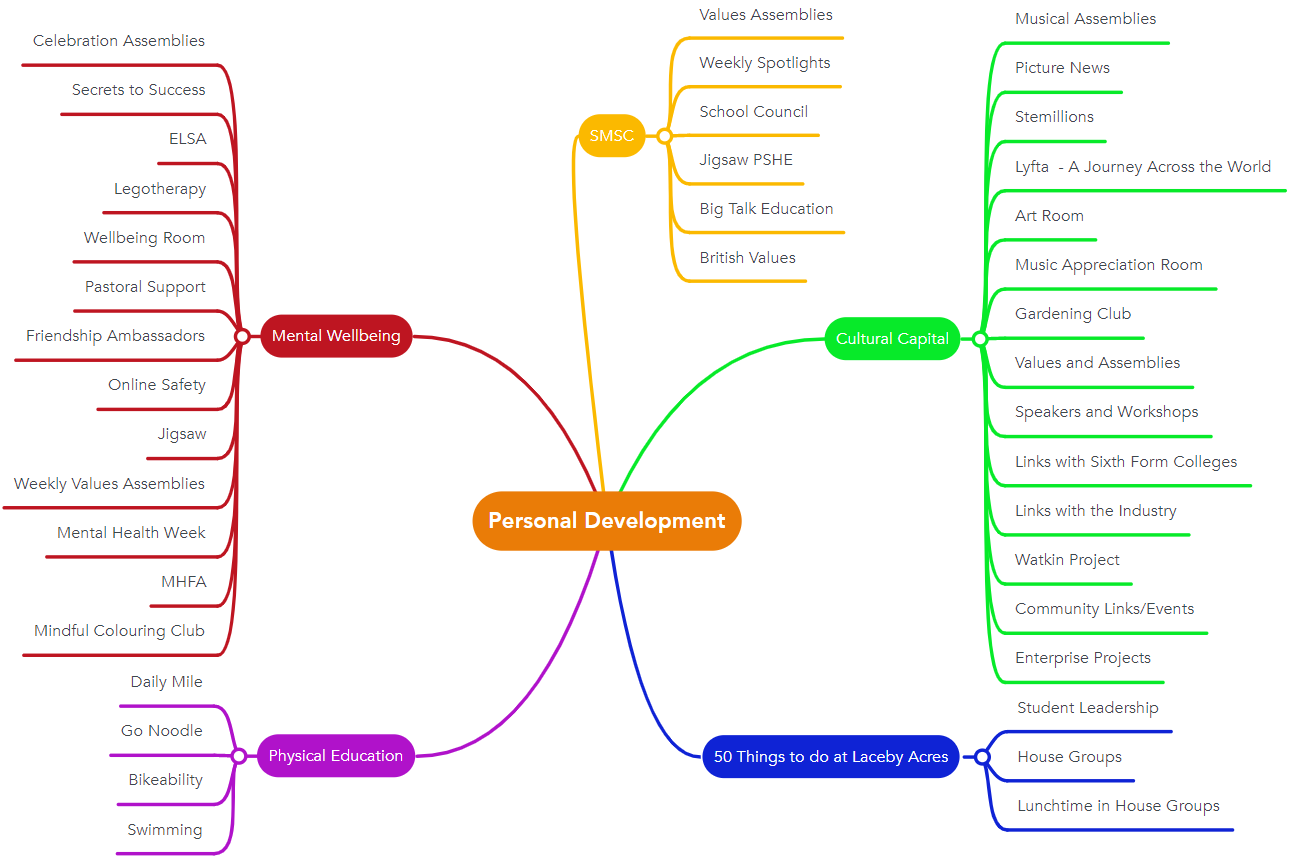
Below is a mind map displaying all the things we do for personal development at Laceby Acres.
Personal Development Mind Map
Assemblies at Laceby Acres are a vital part of developing our whole school community and our opportunity to look at a range of topics. We discuss current affairs and key issues; celebrate festivals of the world; share event days; ask and answer philosophical questions; learn about topics that are essential to personal development and celebrate our successes both in and out of school.
We have a very structured timetable for our assemblies. Every Monday we start with an assembly linked to personal development and discuss important issues such as, ‘what is consent?’ and ‘how do we show respect?’. This is also linked to our whole school ‘spotlight’ focus such as body image and screen time. On a Tuesday our assembly is always linked to special events and festivals of world religions. This is wide ranging and includes assemblies linked to sun safety week, Eid and National Earth day. On a Wednesday we journey across the world through our ‘lyfta’ assemblies. Each week we are transported to a new place in the world and learn about a different culture. Thursday sees us celebrating the joy of music and song. Each Thursday we practice two songs. We aim to learn traditional hymns, classic songs, songs from different cultures and current songs. We finish our week on a Friday with our celebration assembly in which we share our successes from the week linked to our school ‘secrets to success’. We celebrate with free time in the library, a hot chocolate kindly made by Mr. and Mrs Taylor and a biscuit and a chat to our friends and head teacher who is very proud of us.
Each week in assembly we introduce a new piece of music which we feel is vital to our cultural capital. This music ranges from artists across the globe, past and present and covers every genre from rock and pop to classical. Follow our blog to see which music we are listening to this week.